The Whir Bitcoin mixer accepts a deposit, routes it across the Lightning Network, and pays out from an unrelated set of unspent outputs. Unlike a traditional BTC tumbler, there is no long pool, no log database, no registration.
Where a classic Bitcoin tumbler holds a pooled balance for hours and a CoinJoin coordinator needs a synced wallet and patience, the Whir BTC mixer settles each session quickly. An inbound payment is accepted, routed across Lightning channels, and paid back from a different set of unspent outputs. Deposit and payout share no detectable on-chain link.
Funds are held only for the few minutes between deposit confirmation and Lightning payout. There is no long-term user pool.
Session records exist in memory for the mix lifetime and are dropped at payout. No historical database to seize.
The payout looks like a normal Bitcoin transaction. It does not carry the distinctive shape of a CoinJoin.
Each mix is a one-off session with a fresh deposit address. No account, no email, no recovery flow.
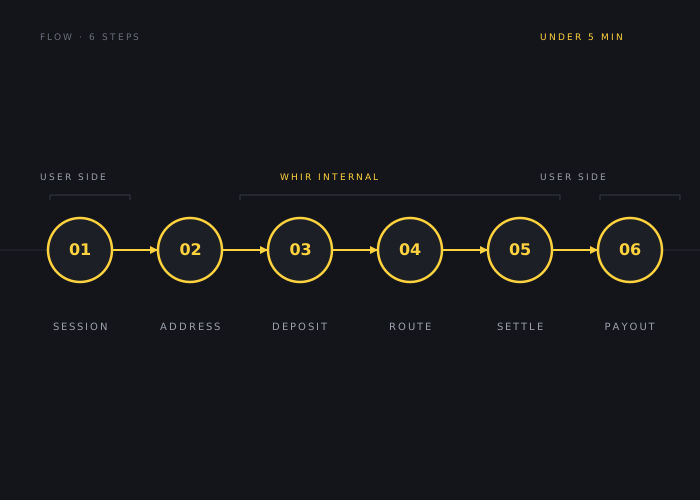
From opening the session to receiving a clean payout, the entire flow runs in under five minutes once the deposit confirms. Six steps, none of which require an account.
A user opens the Whir interface — ideally over Tor — and starts a new session. The mixer generates a one-time deposit address committed to the chosen payout details with a signed letter of guarantee.
Once the deposit confirms, the mixer routes an equivalent value across Lightning. The payout is broadcast on-chain from an unrelated UTXO set held by the operator. The session record is then dropped from memory.
Because deposit and payout share no input ancestry, common heuristic clustering used by chain-analysis firms does not link them.
No registration. The interface is reachable both on the clear net and through a Tor hidden service.
Provide one or several payout addresses with optional split ratios. A signed letter of guarantee is issued.
The deposit is sent to the one-time address. The mixer waits for the chosen number of network confirmations.
Internally, the mixer routes the equivalent amount across Lightning channels — fast, off-chain, and cheap.
The payout is settled from a different set of unspent outputs held by the operator, with no shared ancestry.
The payout transaction is broadcast. Once confirmed, the session record is dropped from memory.
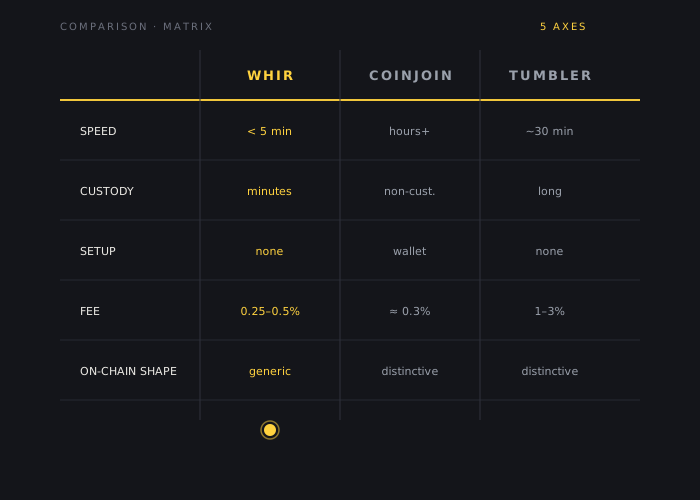
The Whir Bitcoin mixer is not the only privacy tool, and an honest comparison is more useful than marketing. Here is how it lines up against CoinJoin coordinators and against the legacy centralized BTC tumbler model, alongside other crypto mixers.
| Criterion | Whir mixer | CoinJoin | Classic tumbler |
|---|---|---|---|
| Average time | Under 5 minutes | Hours to days | 10–60 minutes |
| Custody window | Minutes only | Non-custodial | Variable, often long |
| Software needed | None — browser only | Specialist wallet | None |
| Service fee | 0.25 – 0.5% | ≈ 0.3% | 1 – 3% |
| Anonymity-set quality | Lightning-wide | Per-round, capped | Pool-size dependent |
| On-chain footprint | Generic payment | Distinctive shape | Often distinctive |
| Tor support | Yes | Depends on wallet | Depends |
You want a private payout in minutes rather than days, you do not want to install or sync a privacy-specific wallet, and you want the on-chain shape to look generic rather than advertising the use of a privacy tool.
For long-term wallet management or fully non-custodial setups, a CoinJoin coordinator is still the right pick. The Whir Bitcoin mixer is built for quick, one-off mixes.
Most mixes complete in under five minutes once the deposit confirms on the Bitcoin network. The Lightning routing itself takes seconds; the on-chain wait for confirmation is the bottleneck.
A 0.5% base service fee, with volume tier discounts down to 0.25% for mixes above one BTC. A small Lightning routing fee is paid to the network on top. See the fees page for worked examples.
No historical database is retained. Session records exist in memory for the mix lifetime and are dropped when the payout is broadcast.
Funds are under operator control only for the few minutes between deposit confirmation and Lightning payout. This is sometimes called a short-window custodial model — meaningfully different from legacy tumblers that held funds for days.
No. There is no account system. Each mix is a one-off session with a freshly generated deposit address.